How to Become a YouTuber in 2026: Zero to Full-Time
Key Takeaways
- •A smartphone, free editing software, and a content strategy are enough to start
- •Good audio quality matters more than video quality for viewer retention
- •Balance search videos, trending videos, and community videos for optimal growth
- •Most channels hit their stride around video 50-100, consistency is everything
- •Layer ad revenue, sponsorships, affiliates, and digital products to maximize income
The YouTube Opportunity in 2026
Becoming a YouTuber comes down to five things: pick a focused niche, set up a channel, publish videos people actually search for, get your first 1,000 subscribers, and turn that audience into income through ads, sponsorships, and your own products. You can start today with the phone in your pocket and free editing software, then reinvest earnings into better gear as you grow.
YouTube remains the most lucrative platform for long-form creators. With over 2.7 billion monthly users and an ad-revenue sharing model that actually pays well, it's the gold standard for building a sustainable content business. Unlike TikTok or Instagram, a single YouTube video can keep earning for years, because search and suggested feeds surface old content to new viewers long after you hit publish.
The barrier to entry has never been lower. A smartphone, free editing software, and a solid content strategy are all you need to get started. The barrier to *finishing* is where most people fail: the average new channel quits before its tenth upload. Treat this as a skill you build over 50 to 100 videos, not a lottery ticket, and you'll already be ahead of the vast majority of people who try.
Step 1: Choose Your Niche
Your niche is the single most important decision you'll make, because it dictates who watches, how fast you grow, and how much you can eventually earn. Pick something specific enough that a stranger can describe your channel in one sentence.
Finding Your Sweet Spot
The best niche sits at the intersection of three things:
- What you know: expertise or lived experience that lets you speak with authority
- What you enjoy: you'll create hundreds of videos, so passion keeps you going through the slow months
- What people search for: audience demand determines how quickly the algorithm can find viewers for you
When all three overlap, you get a channel that's sustainable to make and easy to grow. When one is missing, you burn out (no passion), run out of ideas (no knowledge), or talk to an empty room (no demand).
Go Narrow Before You Go Broad
Beginners lose because they start too broad. "Fitness" is a category with a million channels. "Kettlebell workouts for busy dads over 40" is a niche you can own. A tight focus tells the algorithm exactly who to recommend you to and gives new viewers a reason to subscribe instead of watching one video and leaving. Once you have a loyal audience, you can widen your topics, but earn the right to broaden first.
Niches That Grow Fast in 2026
Personal finance, AI tutorials, health and fitness, productivity, cooking, and tech reviews continue to dominate. Emerging niches include sustainability living, remote work culture, and creator economy content. High-value niches like finance, software, and B2B tools also pay far higher ad rates, often 4 to 8 times more per view than entertainment or gaming, which matters enormously once you monetize.
Validate Demand Before You Commit
Spend an afternoon checking that people actually want your topic. Type your ideas into YouTube's search bar and watch the autocomplete suggestions, which are real queries people type. Look at whether existing videos in the space get tens of thousands of views or a few hundred. A free tool like Google Trends confirms whether interest is rising or fading. If you see recent videos from small channels pulling strong view counts, that's your green light, because it means the niche rewards newcomers, not just established names.
Step 2: Set Up Your Channel
A clean, keyword-aware channel setup takes under an hour and signals to both viewers and the algorithm what you're about. Do this properly once so you never have to rebrand later.
Create the Account
Sign in with a Google account, create a channel, and choose a memorable name that hints at your niche without boxing you in forever. Verify your account with your phone number, which unlocks custom thumbnails, longer videos, and live streaming.
Channel Branding
Choose a memorable channel name, design a clean banner and profile picture, and write a channel description packed with relevant keywords so you surface in search. Add a channel trailer (a 30 to 60 second pitch for new visitors) and organize your videos into playlists, which increases watch time by chaining videos together automatically.
Step 3: Starter Gear and Budget
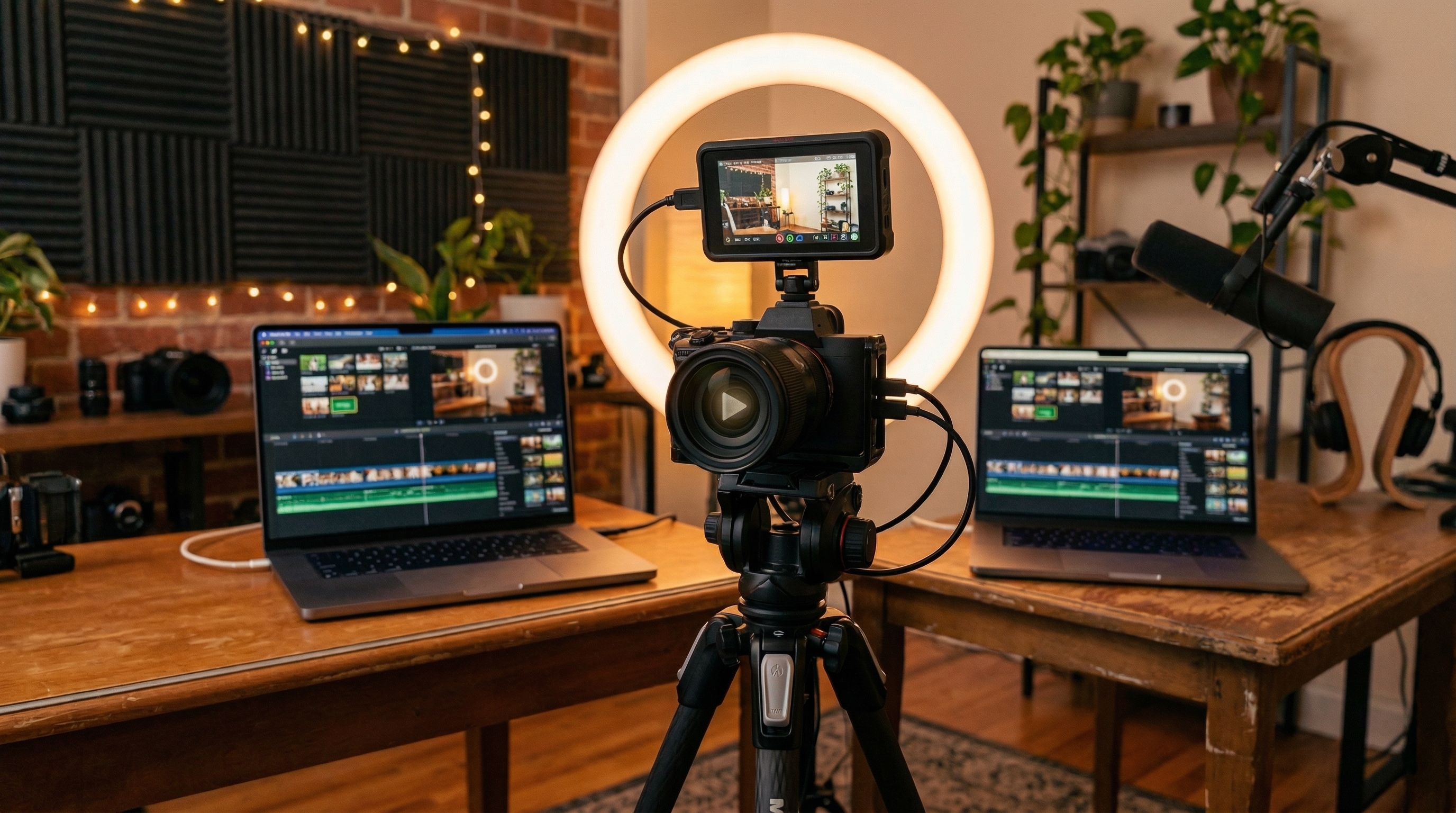
You do not need expensive equipment to start, and audio matters more than video. Viewers will forgive a slightly soft picture, but they click away instantly from echoey or muffled sound. Start with the budget column below, film a dozen videos, and only upgrade the pieces that are actually holding your quality back.
Here is a practical two-tier setup, from a near-free starter kit to a first serious upgrade:
| Gear | Budget pick | Upgrade pick | Approx cost |
|---|---|---|---|
| Camera | Smartphone you already own | Sony ZV-E10 or Canon R50 | $0 vs $650 to $850 |
| Microphone | Rode VideoMicro (on-camera) | Rode Wireless ME lav or Shure MV7 USB | $60 vs $150 to $250 |
| Lighting | Window light or a $30 ring light | Two-point softbox kit | $30 vs $120 to $180 |
| Tripod / mount | Phone clamp tripod | Manfrotto compact tripod | $20 vs $90 |
| Editing software | DaVinci Resolve or CapCut (free) | Adobe Premiere Pro or Final Cut Pro | $0 vs $23/mo or $300 |
| Backdrop / set | Tidy corner of a room | Acoustic panels + simple set dressing | $0 vs $80 to $150 |
The takeaway: a complete starter kit costs under $120, and most of that is optional. Prioritize a good microphone above everything else, then lighting, then camera. A recent smartphone shoots sharp 4K video, so the camera is usually the last thing you should upgrade, not the first.
Step 4: Content Strategy
Your content strategy is what turns random uploads into a channel that compounds. The goal is a mix of videos that attract new viewers through search and trends, plus videos that deepen loyalty with the audience you already have.
The 3-Video Formula
Every successful channel balances three video types:
- Search videos: answer specific questions people Google, like "how to fix X" or "best Y for Z" (steady evergreen traffic that keeps earning for years)
- Trending videos: cover timely topics and news in your niche for short-term algorithm boosts and spikes of new subscribers
- Community videos: behind-the-scenes, Q&As, and personal stories that build loyalty and turn casual viewers into fans
Lean heavily on search videos early. They don't need you to be famous to get views. They just need to answer a real question better than the current top result, which is entirely within your control as a beginner.
Titles and Thumbnails
Your title and thumbnail determine 80% of a video's success. Study what top creators in your niche use, then do it more clearly. Thumbnails should be bold, high-contrast, and readable on a phone screen, with one clear focal point and minimal text (three or four words max). Titles should promise a specific outcome or spark curiosity without lying about the content. Write five title options for every video and pick the strongest. For a deeper framework on ranking in search, see our SEO guide for creators.
Filming: Hook, Retain, Deliver
Retention is the metric YouTube rewards most, so how you film matters as much as what you film. Open with a hook in the first 10 seconds that restates the promise of the thumbnail and tells viewers exactly what they'll get. Cut dead air ruthlessly. Change the shot, angle, or on-screen visual every few seconds to reset attention. Film in a quiet room, point a light at your face, and record a few seconds of silence you can use to clean up audio in editing.
If your niche is tutorial-heavy, screen recordings and clear step-by-step structure outperform talking-head footage. Our guide on how to create tutorial videos breaks down the pacing and structure that keeps instructional viewers watching to the end.
Editing: Where Average Videos Become Great
Good editing is invisible; it just makes the video feel fast. You don't need Hollywood effects. Focus on the fundamentals: cut every pause and filler word, add captions (most watch on mute at first), use simple text callouts to reinforce key points, and add light background music at low volume. Free tools like DaVinci Resolve and CapCut handle all of this. Aim to keep the pace tight enough that there's never a moment where a viewer thinks about clicking away. As you get faster, batch your editing so one long session covers several videos.
Step 5: Getting Your First 1,000 Subscribers
The first 1,000 subscribers are the hardest and the most important, because they unlock monetization and prove your channel resonates. There is no shortcut, but there is a reliable playbook, and it is not "go viral."
Publish Consistently Before You Optimize
The single biggest predictor of hitting 1,000 subscribers is simply uploading enough videos. Most channels that succeed do it somewhere between video 30 and video 100, as the algorithm gathers enough data to learn who to show you to. Commit to one video a week for a year. Frequency beats perfection early, because every upload is a new lottery ticket and a new lesson.
Target Low-Competition Search Terms
As a small channel, you can't out-muscle big creators on broad topics. You can win specific, underserved questions. Look for searches where the current top videos are mediocre, old, or from other small channels. Make the clearly better answer. These "how to" and "best X for Y" videos bring subscribers who found you because they needed exactly what you made, which makes them far more likely to stick around.
Turn Viewers Into Subscribers On Purpose
Views don't automatically become subscribers. Ask directly and give a reason: tell viewers what they'll get if they subscribe ("I post a new budgeting breakdown every Tuesday"). Add a subscribe prompt after you've delivered real value, not at the very start. Use end screens and pinned comments to point viewers to your next best video, which increases watch time and gives them more reasons to commit.
Borrow Other People's Audiences
You don't have to grow in isolation. Collaborate with creators near your size in adjacent niches; a shared video exposes both audiences to each other. Answer questions in the same communities your target viewers hang out in (subreddits, Discord servers, Facebook groups) and link a genuinely helpful video when relevant. Repurpose highlights into YouTube Shorts, TikTok, and Instagram Reels to catch new eyes and funnel them to your channel. A single well-placed Short can add more subscribers in a week than a month of long-form uploads.
Read Your Analytics and Double Down
By your tenth video you'll have data. Open YouTube Analytics and find your two or three best performers by views and average view duration. Make more videos like them. Look at your audience retention graph to see exactly where viewers drop off, and fix that pattern in your next upload. Growth on YouTube is a feedback loop: publish, measure, repeat the winners, cut the losers.
Step 6: Monetization
Once you're growing, YouTube offers more ways to earn than any other platform, and the smartest creators stack several of them. Ad revenue is rarely the biggest line item; your own products and sponsorships usually are.
YouTube Partner Program
You need 1,000 subscribers and 4,000 watch hours (or 10 million Shorts views) in the past 12 months to join. Once accepted, you earn roughly $3 to $8 per 1,000 views depending on your niche, with high-value niches like finance and software paying at the top of that range and entertainment at the bottom. Ad revenue alone is a foundation, not a full income, so treat it as one stream among several.
Beyond Ad Revenue
- Affiliate marketing: recommend products you actually use and earn a commission on every sale from your link; this often out-earns ads at small channel sizes because it doesn't depend on view volume, just trust
- Sponsorships: brands pay anywhere from $1,000 to $20,000+ per integration depending on your size and niche, and finance or tech channels command premiums
- Digital products: sell courses, templates, presets, or coaching to an audience that already trusts you, which is the highest-margin income a creator can build
- Memberships and community: offer exclusive content and perks through YouTube Memberships or a dedicated paid community where your most engaged fans pay monthly for closer access
Diversify Early, Not Late
The creators who earn a full-time living rarely rely on a single source. A realistic mature mix might be 30% ads, 30% sponsorships, and 40% your own products and memberships. Building an audience you own (an email list, a community, a customer base) protects you from algorithm changes and demonetization. For a broader look at stacking income streams as a creator, see our guide on how to make money online.
Step 7: Stay Consistent
The creators who succeed are the ones who don't quit. Publish at least one video per week for your first year. Study your analytics monthly and improve incrementally. Most channels hit their stride around video 50 to 100, so judge yourself on trajectory, not on any single upload.
Set a schedule you can actually keep even in a busy week; a sustainable weekly cadence beats an ambitious daily one you abandon in a month. Batch your filming and editing so a bad week doesn't break your streak. Becoming a YouTuber is less about talent than about showing up long enough to get good, and the compounding nature of the platform means the videos you publish this year keep working for you for years to come.
Written by Daniel Ortega
Daniel is the Head of Content at Affiliateo. With 8+ years in affiliate marketing, he helps creators build profitable programs.