How to Start an Affiliate Program in 2026: Complete Guide

Key Takeaways
- •Affiliate marketing delivers an average 12:1 ROI when run properly
- •Commission rates for digital products typically range from 20-30%
- •Tiered commissions incentivize top performers to sell more
- •Actively recruit affiliates from your existing customer base first
- •Proper tracking and attribution are non-negotiable for program success
Why Affiliate Marketing Still Works in 2026
Learning how to start an affiliate program gives you one of the most cost-effective customer acquisition channels available. Unlike paid ads where you pay upfront with no guarantee of results, affiliate programs let you pay only for actual conversions.
The global affiliate marketing industry is projected to reach $40 billion by 2027, and for good reason: the latest affiliate marketing statistics show an average ROI of 12:1 for businesses that run their programs well.
The appeal is simple: you only pay after a sale is confirmed. That flips the risk of customer acquisition off your balance sheet and onto a network of partners who are motivated to sell for you. A well-run program compounds over time as more affiliates join, more content ranks, and more of your brand gets promoted by people your future customers already trust.
This guide walks through every stage of launching a program from scratch: planning the economics, choosing your commissions, recruiting your first partners, tracking sales accurately, paying out on time, and scaling once you have traction. Work through it in order and you will have a program that is ready to accept its first affiliate.
Step 1: Plan the Economics Before You Launch
Before you pick a commission rate or recruit a single affiliate, you need to know one number: your fully-loaded profit margin per sale. Everything else in your program depends on it.
Start by calculating what you actually keep after cost of goods, payment processing, shipping, refunds, and support. If a $100 product costs you $40 to deliver, you have $60 of gross margin to work with. That $60 has to cover your affiliate commission, your own overhead, and still leave a profit. This is why digital products and subscriptions are the easiest place to start an affiliate program: their marginal cost is close to zero, so almost the entire price is available to share.
Next, decide how you want to count a "sale." Three questions settle most of your program's rules:
- First purchase only, or recurring? For subscriptions, choose whether affiliates earn once, for a fixed number of months, or for the customer's lifetime. Recurring commissions attract better partners because the earnings compound.
- What is your refund and clawback policy? Most programs hold commissions for 30 to 60 days so refunded orders don't get paid out. Decide this now and put it in writing.
- What counts as a valid referral? Define whether coupon-site traffic, brand-name bidding on ads, and self-referrals are allowed. Vague rules here cause most affiliate disputes later.
Write these answers into a short program terms document. It does not need to be a legal treatise, but affiliates should be able to read it in five minutes and know exactly how and when they get paid. Clear terms up front prevent the vast majority of payout arguments down the line.
Setting Up Your Commission Structure
Your commission structure is the single most important decision you'll make. Too low and affiliates won't promote you, too high and you'll eat into margins, so it pays to design commission structures that actually convert.
Percentage vs Fixed Commissions
Percentage commissions work best for products with varying price points. A 20-30% commission on digital products is standard, while physical products typically range from 5-15%.
Fixed commissions are ideal when you want predictable costs per acquisition. They work especially well for subscription products where the lifetime value is high.
Tiered Commission Models
Consider implementing tiers to reward your top performers:
- Bronze: 15% commission (0-10 sales/month)
- Silver: 20% commission (11-50 sales/month)
- Gold: 25% commission (51-100 sales/month)
- Platinum: 30% commission (100+ sales/month)
Commission Benchmarks by Industry
The fastest way to price your program is to look at what already works in your category. The table below shows typical commission ranges across common industries so you can position your offer competitively rather than guessing. Treat these as ranges, not rules: your margins and lifetime value should always have the final say.
| Industry | Typical commission rate | Notes |
|---|---|---|
| SaaS and software | 20-40% recurring | Recurring pay is the norm; many run 30% for the first 12 months of a subscription |
| Digital products and courses | 30-50% | High margins allow generous rates; 40% or more is common for info products |
| Web hosting | $50-$150 flat, or 40%+ | Often a fixed bounty per sale plus a recurring share |
| Email and marketing tools | 20-50% recurring | Lifetime-value focus drives long recurring windows, often 12 months |
| Fashion and apparel | 5-15% | Thin margins keep rates low; higher for premium and full-price items |
| Beauty and cosmetics | 8-20% | Repeat-purchase products can justify the upper end |
| Health and supplements | 15-40% | High margins and strong LTV support aggressive rates |
| Consumer electronics | 2-8% | Low margins force low rates; volume is the play |
| Home and furniture | 5-12% | Higher ticket sizes offset lower percentages |
| Finance and insurance | $50-$200 flat | Usually a fixed bounty per qualified lead or funded account |
| General retail marketplaces | 1-10% | Amazon-style category rates; low but high-intent traffic |
| Travel and hospitality | 4-10% | Percentage of booking value, sometimes flat per booking |
Two rules of thumb make these numbers actionable. First, on recurring products, a slightly lower percentage that pays for 12 months usually beats a bigger one-time payout for attracting serious affiliates. Second, if you sit at the bottom of your industry's range, expect to compete on brand and conversion rate instead of on the offer itself.
Cookie Windows and Attribution
Your commission rate gets the attention, but your cookie window quietly decides how many sales actually get credited. The cookie window is how long after a click an affiliate still earns credit if the customer buys. Thirty days is the most common default. Shorter windows (24 hours to 7 days) favor high-intent, last-click traffic; longer windows (60 to 180 days) reward affiliates who create content that builds trust over weeks before a purchase.
Also decide your attribution model. Last-click, where the final referrer before purchase gets paid, is the standard and the easiest to explain. Generous programs sometimes pay first-click or split credit, but last-click keeps disputes rare. Whatever you choose, state the cookie length and attribution model plainly in your terms so affiliates can forecast their earnings honestly.
Recruiting Your First Affiliates
The biggest mistake new programs make is waiting for affiliates to come to them. You need to actively recruit.
Where to Find Quality Affiliates
Start with your existing customers: they already love your product. Reach out to industry bloggers, YouTubers, and newsletter creators, and lean on proven affiliate marketing strategies to win them over. Join affiliate networks and list your program in directories.
A practical recruiting order that works for most new programs:
- Your happiest customers first. Email or in-app message people who already use and rate your product. They convert to affiliates at far higher rates than cold prospects because the trust already exists.
- Content creators who rank for your keywords. Search the terms your customers use to find products like yours, then reach out to the bloggers and YouTubers who already appear on page one. Their audience is your audience.
- Newsletter and community operators. A single creator with an engaged 5,000-person email list often outperforms a much larger but passive social following.
- Complementary, non-competing brands. If you sell project templates, someone selling a course on the same workflow reaches the exact buyer you want.
- Existing affiliates in your niche. People who already promote a competitor know how to sell in your category and can often add you as a second recommendation.
Writing an Irresistible Affiliate Pitch
Your pitch should cover three things: what your product does, how much they'll earn, and why their audience will love it. Include conversion rates and average order values to help affiliates estimate their earnings.
The single most persuasive thing you can add is a concrete earnings example. "You earn 30%" is abstract. "Our page converts around 4% and our average order is $120, so 1,000 clicks from your audience is roughly $1,440 to you" is a number a creator can picture. Keep the outreach human and specific: say why you chose this person and how the partnership helps their audience, not just your revenue. A short, personal message with real numbers beats a polished template every time.
Onboarding Affiliates So They Actually Promote
Recruiting is only half the job. A large share of affiliates who sign up never send a single click, usually because they were left to figure it out alone. Reduce that drop-off by making the first week effortless:
- Send ready-to-use assets: pre-written copy, banners, product images, and a few example posts.
- Give them their tracking link on day one and confirm it works with a test click.
- Share your best-converting angles and the pages that already sell well.
- Set a light expectation, like one promotion in the first two weeks, so momentum starts early.
Tracking and Analytics
Proper tracking is non-negotiable. You need to attribute every sale accurately, handle cookie windows, and prevent fraud.
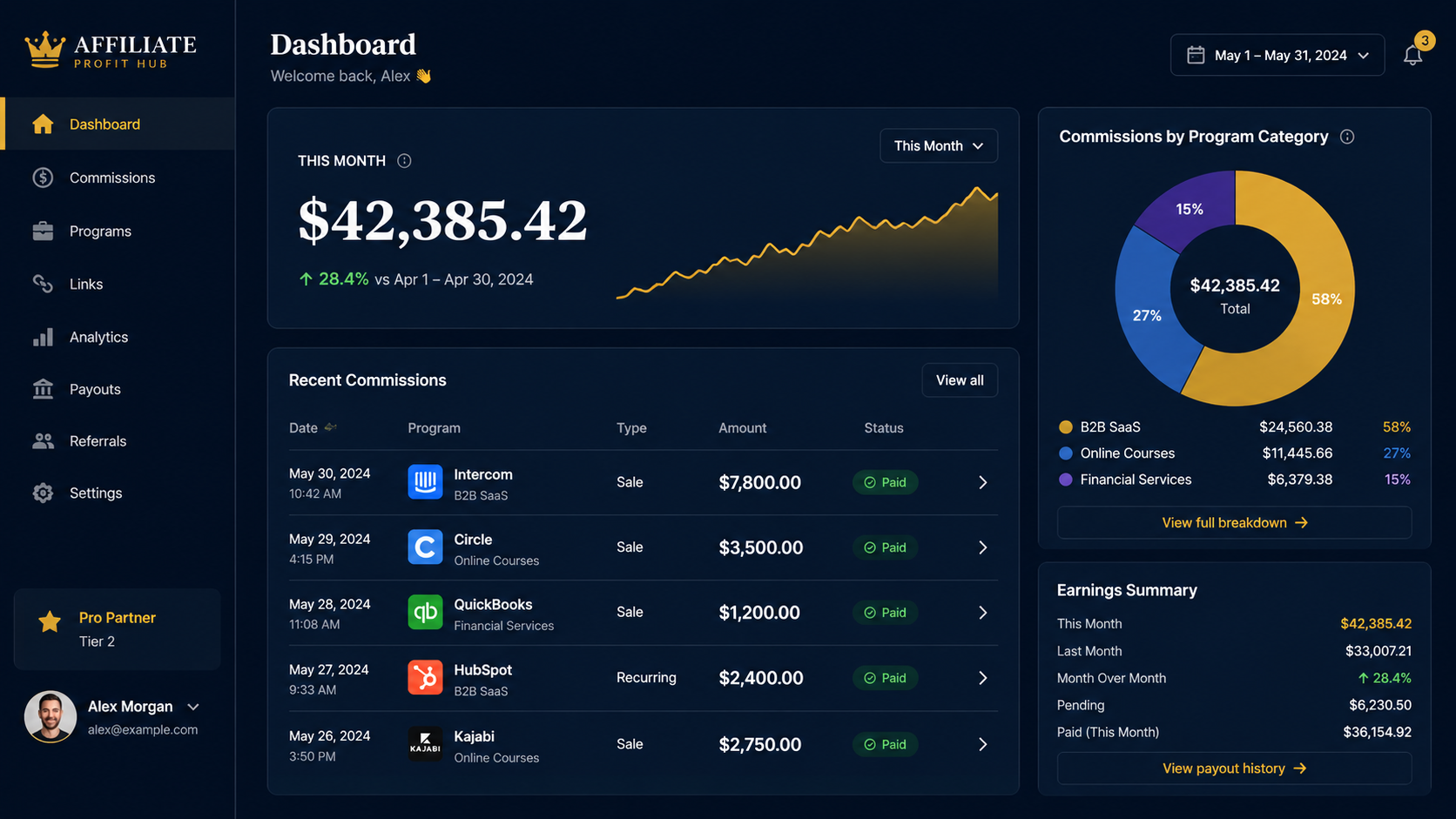
Use a platform like Affiliateo that provides real-time dashboards, automated payouts, and detailed performance reports for both you and your affiliates.
The Metrics That Actually Matter
Do not drown in data. Four numbers tell you whether your program is healthy:
- Clicks per affiliate shows who is actually promoting versus who signed up and went quiet.
- Conversion rate (sales divided by clicks) tells you whether your landing page or your traffic quality needs work.
- Earnings per click (EPC) is the number affiliates care about most; it lets them compare your program to others at a glance.
- Active affiliate rate, the share of your affiliates who drove at least one sale this month, is the truest measure of program health.
Preventing Fraud and Protecting Margins
As soon as money is on the line, some traffic will be low quality. The common problems are self-referrals, coupon-code leaking to public deal sites, and brand-name ad bidding that steals sales you would have won anyway. Guard against these by holding commissions for a refund window before paying, excluding self-purchases automatically, and stating clearly in your terms which traffic sources are banned. A platform with built-in fraud checks and a hold period does most of this work for you.
Paying Out Affiliates
Reliable, on-time payouts are what turn a one-time promoter into a long-term partner. Nothing kills a program faster than late or confusing payments, so systematize this from day one.
Set three things and publish them in your terms: a payout schedule (monthly, on a fixed date like the 1st, is the most common), a minimum payout threshold (often $25 to $100, which keeps tiny transfers from eating fees), and a hold period (typically 30 to 60 days so refunded sales are removed before payment). Together these protect your margins while giving affiliates a predictable rhythm they can count on.
Automate the mechanics wherever you can. Manual spreadsheet payouts break down the moment you have more than a handful of active affiliates, and a single missed payment damages trust that took months to build. A platform that calculates commissions, applies the hold period, and sends payments automatically removes the busywork and the errors at the same time. Whatever you use, make sure affiliates can see their pending, held, and paid balances in real time: transparency here prevents almost every payment dispute.
Scaling Once You Have Traction
A program that works with 10 affiliates does not automatically work with 100. Scaling is a deliberate phase, not something that just happens.
The most reliable growth lever is doubling down on your winners. In most programs a small group of "super affiliates" drives the majority of sales. Find that top 10 to 20 percent and invest in them directly: give them higher tiers, early access to launches, custom creative, and a real relationship. One motivated super affiliate is often worth fifty passive sign-ups, so your time compounds fastest when spent here.
Once your top partners are locked in, widen the funnel:
- Introduce performance tiers so affiliates have a reason to push for the next level, using a bronze-to-platinum ladder like the one earlier in this guide.
- Run limited-time bonuses, for example an extra 5% on all sales during a launch week, to re-activate quiet affiliates and reward your active ones.
- Recruit continuously, not in bursts. A steady trickle of new partners keeps the program growing even as some naturally churn out.
- Refresh your creative and offers regularly so affiliates always have something new to promote to the same audience.
Keep leaning on proven affiliate marketing strategies as you grow, and revisit your commission structure once you have real data on which rates and products actually convert. What you guessed at launch is rarely what the numbers tell you six months in.
Staying Compliant: FTC Rules and Disclosures
Affiliate relationships are paid endorsements, and in most markets that triggers disclosure rules. In the United States, the FTC requires affiliates to clearly disclose that they earn a commission: a visible "this post contains affiliate links" or "#ad" placed where readers actually see it, not buried at the bottom of a page. Put this requirement directly in your program terms and remind affiliates of it during onboarding. Non-compliance is a reputational and legal risk that lands on your brand as well as the affiliate, so make it a condition of participation rather than an afterthought.
Common Mistakes to Avoid
Don't set and forget your program. Monitor affiliate quality, respond to questions quickly, and update your promotional materials regularly. The best programs treat affiliates as partners, not just a marketing channel.
A few specific traps sink new programs more often than any other:
- Pricing the commission before knowing your margin. If you cannot comfortably afford the rate, you will quietly resent the program and underinvest in it.
- Recruiting affiliates and then going silent. A partner who does not hear from you in the first two weeks usually never activates.
- Making payouts slow, manual, or opaque. This is the fastest way to lose your best affiliates to a competitor who pays cleanly.
- Ignoring the data. The affiliates and products you expected to win are often not the ones that actually do; let the numbers, not your assumptions, decide where you invest.
Avoid these, keep the loop of recruit, support, pay, and reward turning, and an affiliate program becomes one of the few marketing channels that gets cheaper and more effective the longer it runs.
Written by Daniel Ortega
Daniel is the Head of Content at Affiliateo. With 8+ years in affiliate marketing, he helps creators build profitable programs.