How to Price Your Digital Products for Maximum Revenue
Key Takeaways
- •Zero marginal cost means cost-plus pricing tells you nothing, so price against the buyer's alternative instead
- •Low prices attract the most demanding customers, the most refund requests and the most support load
- •High pricing is often easier than mid for someone starting out, because a small audience can support a high-priced product and cannot support a cheap one
- •No price objections at all means you are too cheap: a healthy price generates occasional ones
- •Underpricing makes your affiliate program uncompetitive, because a small commission is not worth a partner's slot
Digital product pricing has one property that makes it fundamentally different from pricing anything physical: the marginal cost is effectively zero, which means cost-plus pricing gives you no information at all. There is no floor derived from what it costs to make.
That sounds freeing and it is actually the problem. With no anchor, most people default to comparing themselves to other products that look superficially similar, which is how excellent products end up priced like commodity ones.
Price on the outcome, not the artefact
The question buyers actually answer is not "is this worth 49 dollars as a document". It is "is this worth 49 dollars compared to the alternative, which is doing it myself or not doing it at all".
That reframe changes what you should be measuring:
- What does the problem cost them right now? In money, time or frustration.
- What is their alternative? Another product, hiring someone, figuring it out themselves, or doing nothing.
- How quickly do they get the result? Speed to outcome carries real value and is frequently underpriced.
A template that saves a professional six hours is worth a meaningful fraction of six hours of their rate. The same template sold to a hobbyist who has unlimited time and no hourly rate is worth very little. Same file, entirely different price, because the value is in the outcome rather than in the object.
The three positions and what each requires
Digital products cluster at three price points, and the middle one is the hardest place to be.
Low, roughly under 50. Impulse purchase, minimal deliberation. Requires volume, which means distribution is the whole game. Works when you have search traffic or an audience already. Support burden per customer is disproportionate at this level, which people rarely account for.
Mid, roughly 50 to 500. Considered purchase requiring an actual sales page and social proof. The most contested position, because there is enormous supply here and buyers compare carefully.
High, above 500. Requires trust, specificity, and usually some human element such as access, support or a community. Fewer sales, and the economics work at low volume, which suits creators without large audiences.
The counterintuitive point is that high is often easier than mid for someone starting out, because a small audience can support a high-priced product and cannot support a low-priced one.
The mistake almost everyone makes
Pricing low to be accessible.
It fails for three reasons that are not obvious in advance:
1. Low prices attract worse customers. Consistently. The lowest-priced tier generates the most support requests, the most refund requests and the most difficult interactions, in every category where people have measured it.
2. Price signals quality when nothing else does. A buyer who cannot evaluate the product before purchase uses price as information. Very cheap reads as low value, which reduces conversion rather than increasing it.
3. The volume required is unreachable. At 20 dollars, hitting a meaningful monthly income requires hundreds of sales. At 200, it requires tens. Most people cannot reach hundreds and can reach tens.
Raising prices later is possible and it is harder than starting higher, because existing customers anchor and comparison sites cache your old price.
Structures that work
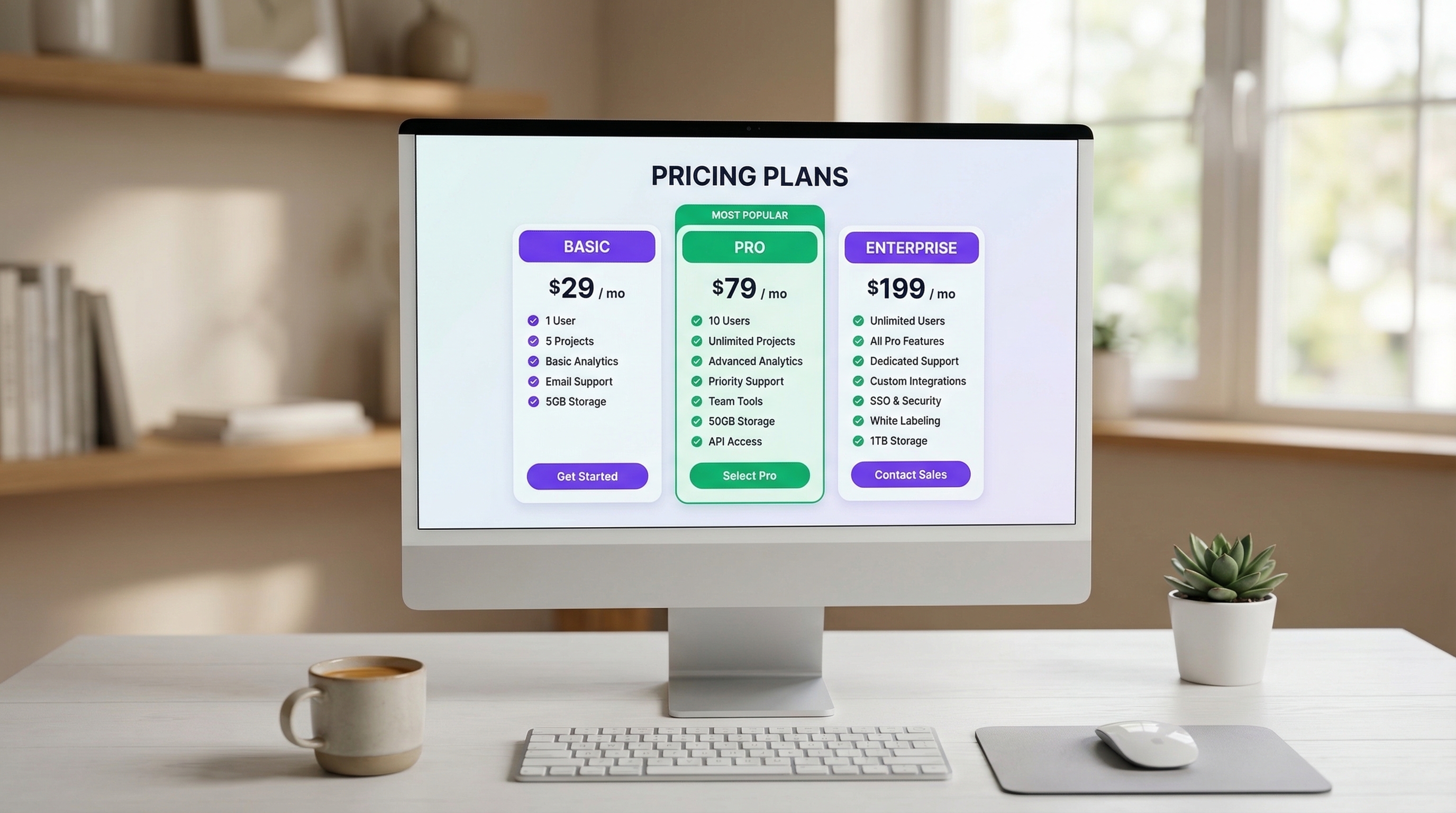
Tiers
Two or three options at different prices. The mechanics that matter:
- The middle tier is what most people choose, so make it the one you actually want them on.
- The top tier makes the middle look reasonable even if few people buy it. It is doing pricing work regardless of its sales.
- Tiers should differ by outcome, not by feature count. "More templates" is a weak differentiator. "Includes the implementation call" is a strong one.
Bundles
Raise average order value and reduce the per-product marketing burden. Works well when the products genuinely belong together and badly when the bundle is obviously padding.
Payment plans
Three payments of 99 converts better than one payment of 297 for higher-priced products. The tradeoff is failed payments on later instalments, which is a real cost. The subscription billing best practices guide covers recovering those.
Recurring
Where the value is genuinely ongoing, a subscription is worth substantially more over time than a one-off at a higher price. The requirement is that there is a real reason to still be paying in month six.
Testing without a large audience
Split testing needs traffic most creators do not have. What works instead:
- Sequential pricing. Launch at one price, gather sales and objections, raise it, observe. Slower and does not need statistical significance.
- Ask. Interview buyers about what else they considered and what they expected to pay. Qualitative, and informative in a way analytics is not.
- Watch objections. If nobody mentions price, you are too cheap. If everyone does, you are too expensive or the value is not communicated. A healthy price generates occasional price objections, not none.
That last heuristic is the most practical one here. No price objections at all means you are leaving money on the table.
Discounting, carefully
Discounts train buyers to wait. A product that goes on sale quarterly will not sell at full price in the intervening months.
Where discounting is defensible:
- Genuine launch pricing, clearly time-limited, for a genuinely new product.
- Bundles where the discount is for buying more.
- Segments where you are deliberately serving a lower-price market with a different offer.
Where it is not: recurring sales on the same product at the same price point, which is just a lower price with extra steps.
Currency and international pricing
If you sell internationally, a single dollar price means very different things in different markets. Two approaches:
- One global price. Simple, and it prices out entire markets.
- Local price points, set deliberately per market rather than converted at a live rate. Better conversion, more maintenance, and it lets you price to local purchasing power.
The cross-border payments guide covers the mechanics of getting paid in multiple currencies.
A workable process
1. Identify the alternative your buyer would otherwise use, and what it costs them.
2. Price relative to that outcome, not to your effort or to superficially similar products.
3. Start higher than feels comfortable. You can discount; unwinding a low anchor is harder.
4. Build tiers where the middle is what you want most people to buy.
5. Watch objections rather than conversion rate alone.
6. Raise the price once you have social proof, and keep raising it while the objection rate stays healthy.
If you run an affiliate program
Price affects partner behaviour directly. A 30 percent commission on a 30 dollar product is nine dollars, which is not worth an affiliate's slot. The same rate on a 300 dollar product is ninety, which is. Underpricing does not only cost you margin, it also makes your program uncompetitive against everything else in your partners' inboxes. The commission structures guide covers the arithmetic from the partner's side.
Written by Nina Kowalski
Nina is an educator and course creator who has generated over $2M in online course revenue.