LinkedIn Affiliate Marketing: The B2B Channel for 2026
Key Takeaways
- •LinkedIn works for B2B software, professional education and business services, and not for consumer products
- •The platform reduces distribution on posts with outbound links, so write posts that are complete without the link
- •A single B2B conversion with recurring commission can be worth more than hundreds of consumer sales
- •The durable structure is LinkedIn post to owned newsletter or email list to detailed content on your own site
- •Engagement is public and attached to a real employer, which suppresses interaction with anything personal or lifestyle-oriented
LinkedIn is the wrong platform for most affiliate marketing and an unusually good one for a narrow slice of it. Understanding which slice is the entire question, because the audience is expensive to reach, intolerant of consumer promotion, and extremely valuable when the offer matches.
The short version: LinkedIn works for B2B software, professional education, business services and career tools. It does not work for consumer products, and posting consumer affiliate links there will cost you reach and credibility for no return.
Why the audience is different
Three things distinguish LinkedIn from every other social platform.
- The purchase authority is different. A meaningful share of the audience can approve business spending, which means a single conversion can be worth far more than a consumer sale. A B2B software referral converting at a few hundred dollars in recurring commission changes the arithmetic entirely.
- Identity is real and persistent. People post under their actual name with their actual employer attached. That raises the cost of a bad recommendation and the value of a good one.
- Overt selling is penalised socially and algorithmically. The platform de-prioritises posts with outbound links, and the audience reacts badly to obvious promotion. Both constraints push toward the same strategy.
What actually converts
B2B software and SaaS
The strongest category by a wide margin. Recurring commissions, a professional audience with budget, and a genuine appetite for tool recommendations from practitioners.
The content that works is not a review. It is a description of a problem you had and how you solved it, where the tool is part of the answer. The reader is evaluating whether you understand their situation, and the recommendation is credible only if the problem description is.
Professional education and certification
Courses, certifications and training with a clear career outcome. Converts because the buyer has a specific goal and the purchase is often reimbursable.
Business services
Accounting, legal, formation, payroll, insurance. High value per conversion, long consideration, and a strong fit for content that explains the decision rather than the product.
Career and productivity tools
Resume services, job platforms, writing tools. Moderate value, broad appeal, and easily overdone. This is the category most likely to tip into spam if the frequency is wrong.
What does not work
Consumer goods, lifestyle products, anything requiring impulse purchase, and anything where the audience would be embarrassed to be seen engaging with it. That last point is underrated: LinkedIn engagement is public and attached to a real employer, which suppresses interaction with anything personal.
The link problem, and how to work around it
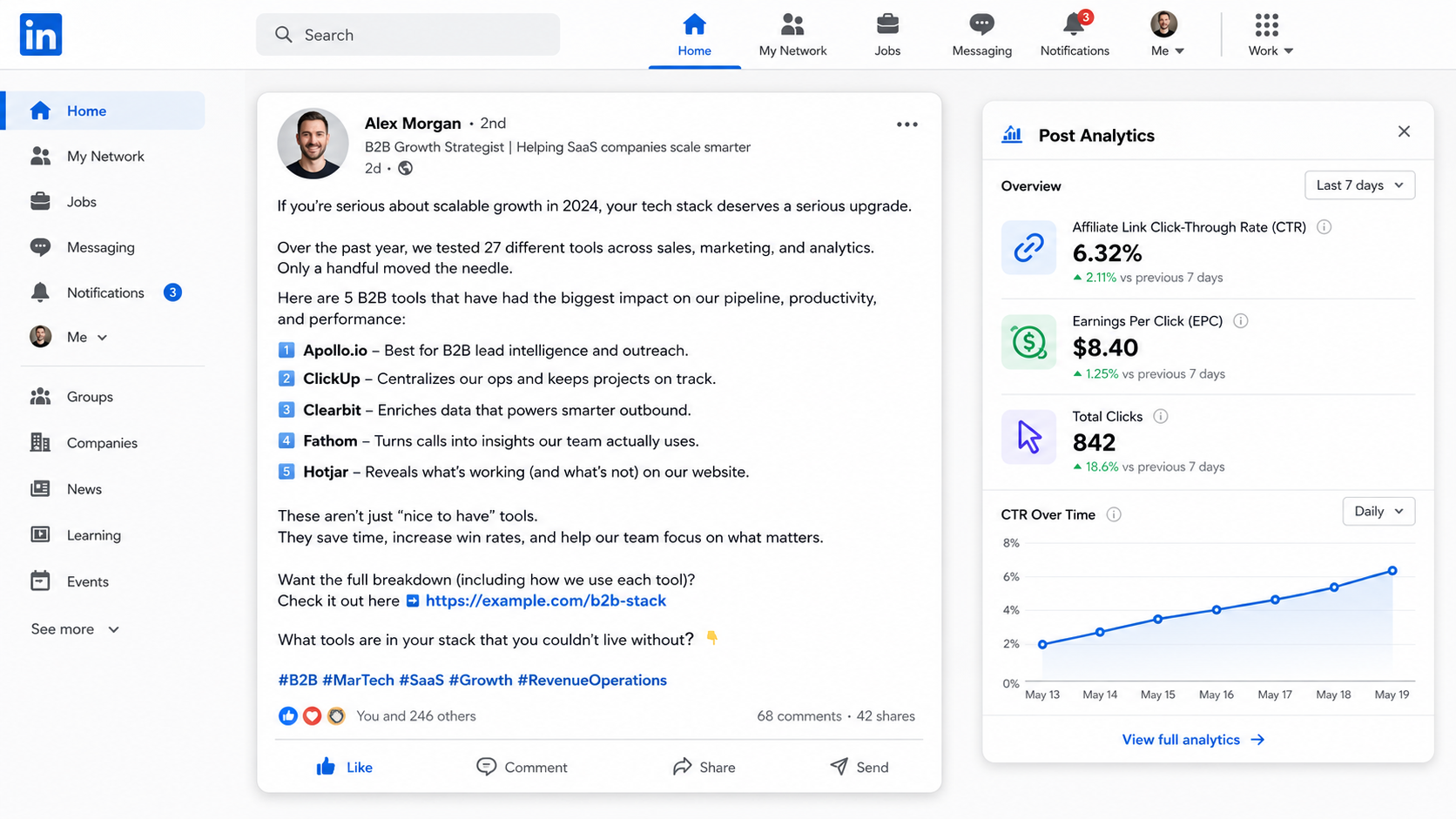
LinkedIn reduces distribution on posts containing outbound links. This is well established and it shapes everything about how content is structured there.
The workarounds, in order of how well they work:
1. Write the post to be complete without the link. The post delivers the value, and the link is available for people who want the next step. This performs best and is also simply better content.
2. Put the link in the first comment. Widely used, mildly effective, and increasingly obvious to readers.
3. Point at your profile or newsletter rather than an external destination, and convert there.
4. Use LinkedIn's newsletter feature, which keeps people on platform and has good notification mechanics, then link from inside it.
The strategic answer is the fourth one combined with the first. Build the audience on LinkedIn, move them to something you own, and monetise there rather than trying to convert in-feed.
Content formats that work
The problem breakdown. A specific operational problem, what you tried, what failed, what worked. The tool appears as part of the resolution. This is the highest-trust format on the platform.
The comparison from experience. Two tools you have actually used in production, with the specific situations each suits. Credible because it contains details a non-user could not produce.
The numbers post. A real result with real figures, including the caveats. Works because the platform is starved of concrete numbers and full of vague claims.
The correction. Publicly revising something you previously recommended. Rare, memorable, and does more for credibility than any amount of positive content.
What fails: motivational content with a link attached, listicles of tools you have not used, and anything that reads as if it were written for the algorithm rather than a reader.
Disclosure on LinkedIn specifically
Disclosure is required, and on LinkedIn it is also strategically sensible. The audience is professionally sophisticated and will assume a commercial relationship exists whether you declare one or not. Declaring it removes the suspicion and costs nothing.
A plain line in the post is sufficient. Attempting to hide it in a professional context where your real name and employer are attached is a poor risk.
Building the audience
The uncomfortable truth is that LinkedIn affiliate income scales with credibility rather than with follower count, and credibility is built slowly through consistent, specific, useful posting.
What compounds:
- A narrow, identifiable topic. People follow you for a subject, not for general business content.
- Frequency over polish. Consistent adequate posts beat occasional excellent ones on this platform, because the distribution system rewards recency.
- Engaging genuinely on other people's posts. Thoughtful comments on relevant posts are the most efficient reach mechanism available and almost nobody does them properly.
- A newsletter. LinkedIn newsletters notify subscribers, which is a substantial distribution advantage over ordinary posts.
Realistic economics
A LinkedIn affiliate operation with a few thousand relevant followers in a B2B niche can generate meaningful income, because the value per conversion is high and recurring. The same audience size in a consumer niche generates approximately nothing.
The variables that matter, in order:
1. Is the offer B2B with recurring commission? If not, this is likely the wrong platform.
2. Is your audience the buyer or the user? Users recommend, buyers approve. Both are useful, differently.
3. Do you have credibility in the specific topic? General business credibility does not transfer to a tool recommendation.
Where to send the traffic
Given the link penalty, the durable structure is:
LinkedIn post, which builds credibility and reach, leading to a LinkedIn newsletter or your own email list, which you own, leading to detailed content on your own site, where the affiliate recommendation lives with full context and proper tracking.
That third step matters for measurement as well as conversion. A click from a LinkedIn comment into a merchant site gives you almost no data. A click through your own domain gives you a first-party record you can connect to a settled sale.
For the tracking mechanics, best affiliate email marketing platforms covers the link configuration that preserves attribution, and high-ticket affiliate marketing covers the offer selection that makes a professional audience worth the effort of building.
Written by Daniel Ortega
Daniel is the Head of Content at Affiliateo. With 8+ years in affiliate marketing, he helps creators build profitable programs.