The 20 Best Items to Flip for Profit in 2026
Key Takeaways
- •Any category widely known as profitable attracts competition, so the durable advantage is knowledge rather than category choice
- •Everything flippable is a version of one thing: a gap between what sellers accept and what buyers pay
- •Bulky light items are the most common trap, because dimensional weight charges them as though they were heavy
- •Selling a counterfeit even unknowingly is a legal problem as well as an account problem, and in high-value categories the fakes are very good
- •Existing knowledge in any category beats a theoretically better category you know nothing about
Twenty categories that reliably resell, with what makes each one work and what makes it hard. The honest framing first: any category that becomes widely known as profitable attracts competition, so the durable advantage is knowledge rather than category selection.
The characteristics that make anything flippable: a large gap between what sellers accept and what buyers pay, driven by information asymmetry, inconvenience or urgency. Every entry below is a version of that.
Highest margins, requires knowledge
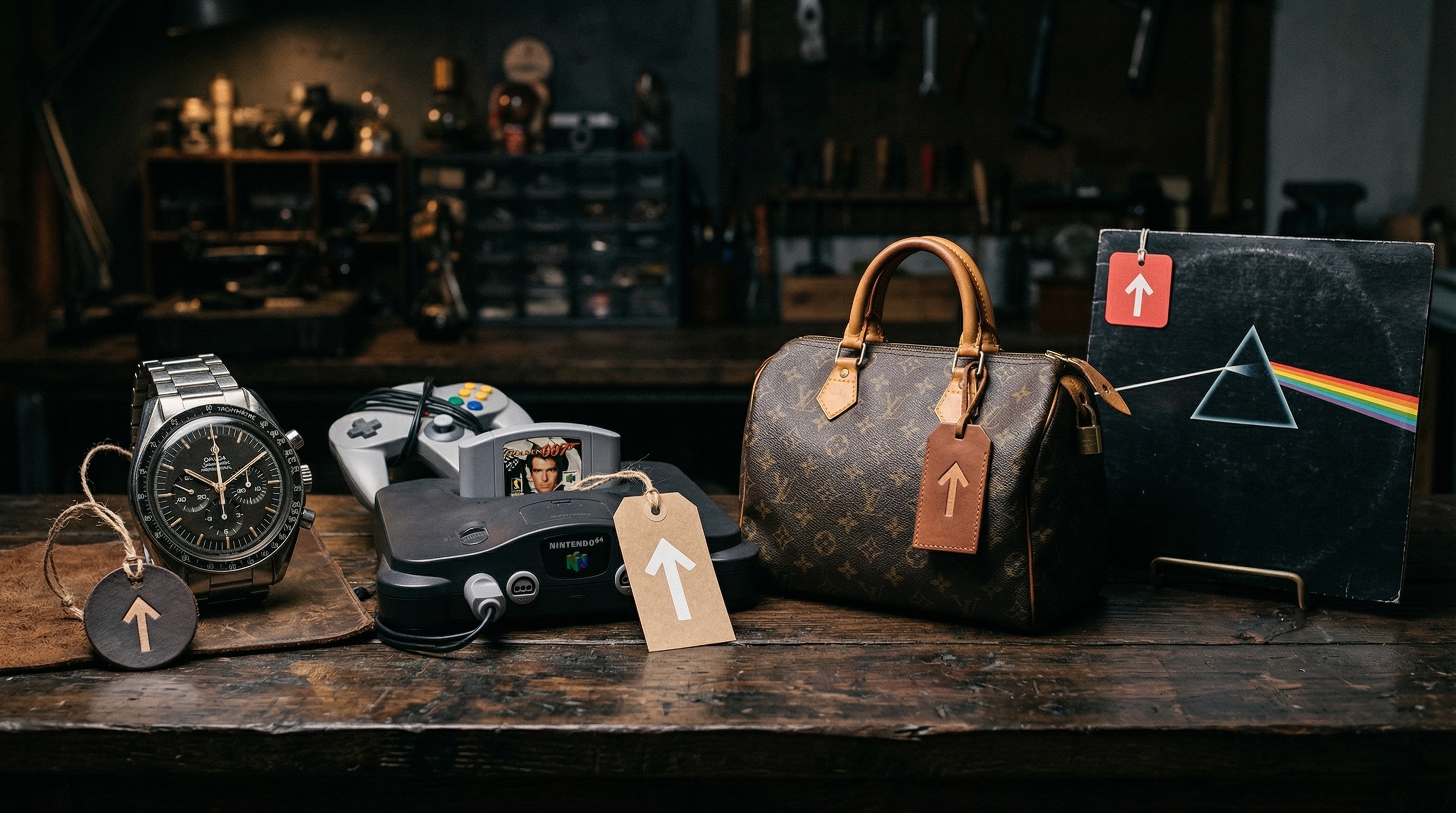
1. Vintage and branded clothing
Consistent demand, huge supply in thrift shops, and value that depends entirely on recognising brands, eras and condition.
Hard part: the knowledge takes months. Upside: it is the most accessible high-margin category.
2. Sneakers
Established resale market with transparent pricing on dedicated platforms.
Hard part: authentication, competition from bots on releases, and thin margins on common models. See how to sell sneakers on GOAT.
3. Watches
High values, strong demand, and a genuine expertise barrier.
Hard part: counterfeits are sophisticated, and a mistake is expensive. See how to flip watches.
4. Designer handbags
Strong resale values and a well-established secondary market.
Hard part: counterfeiting is endemic and skilled. Authentication is the entire business. See where to sell designer bags.
5. Vintage furniture
Mid-century and designer pieces sell strongly, and are frequently given away by people who do not recognise them.
Hard part: transport and storage. Local sale usually, which caps the buyer pool.
Steady demand, moderate knowledge
6. Tools
Quality hand and power tools hold value, tradespeople buy used readily, and they are compact and durable.
Hard part: testing electricals, and knowing which brands hold value.
7. Musical instruments
Good brands hold value well and buyers are knowledgeable.
Hard part: condition assessment, shipping fragile items, and setup affecting value.
8. Cameras and lenses
Film cameras have had a sustained resurgence, and quality lenses hold value for decades.
Hard part: testing, and fungus or haze that is invisible without checking.
9. Board games and puzzles
Out-of-print editions command real premiums, and they are light and durable.
Hard part: completeness. A missing piece destroys the value.
10. Books
Textbooks, first editions, out-of-print and technical books.
Hard part: most books are worth nothing, so this is entirely about identifying the small proportion that are not.
11. Lego
Retired sets appreciate reliably, and even loose bricks sell by weight.
Hard part: completeness verification is laborious, and sets are bulky to ship.
12. Video games and consoles
Retro titles and hardware have strong collector demand.
Hard part: condition of packaging matters enormously, and testing takes time.
Volume categories
13. Kitchenware and small appliances
Quality brands sell consistently, and are frequently discarded when working.
Hard part: bulk and weight make shipping expensive.
14. Sporting goods
Golf clubs, bicycles, gym equipment. High initial purchase prices and rapid abandonment by owners.
Hard part: bulky, and frequently local sale only.
15. Baby and children's equipment
Used briefly, replaced constantly, and expensive new.
Hard part: safety recalls, expiry dates on car seats, and hygiene expectations.
16. Homeware and decor
Constant demand and enormous supply.
Hard part: low value per item, so it only works at volume.
Specialist categories
17. Trading cards
Established grading and pricing infrastructure.
Hard part: highly speculative, prices move sharply, and grading costs money and time.
18. Jewellery
Precious metals have a floor value regardless of style.
Hard part: testing for authenticity, and understanding the difference between scrap value and retail value.
19. Auto and machine parts
Discontinued parts command large premiums because owners need them specifically.
Hard part: requires real category knowledge, and heavy shipping.
20. Vinyl records
Sustained demand, and pressing variants matter enormously to buyers.
Hard part: condition grading is precise and buyers are unforgiving.
How to choose between them
Four filters, in order:
What do you already know? Existing knowledge in any category beats a theoretically better category you know nothing about.
What is available near you? A category with no local supply is not a business.
What ships well? Bulky and fragile items eat margins through dimensional weight shipping and damage claims.
How much capital does it need? Watches and handbags require serious capital per item. Clothing and books do not.
The characteristics of a good flip
Regardless of category:
- Bought below market, which is where the profit is made
- Recognisable brand, so buyers can evaluate it
- Verifiable condition
- Ships without breaking
- Sells within a reasonable window, since capital tied up in slow stock is capital not working
- Not counterfeited heavily, or you have genuine authentication ability
That last point matters more than people expect. Selling a counterfeit item, even unknowingly, is a legal problem as well as an account problem, and in the high-value categories the fakes are very good.
The arithmetic
For any item: purchase price, platform fees, payment processing, shipping and materials, return risk, and your time. Many apparently profitable flips are not once all of it is counted.
Bulky light items are the most common trap, because dimensional weight charges them as though they were heavy. See cheapest way to ship products.
The ceiling
Every category here is capped by your sourcing time, and profit per hour stays roughly constant regardless of experience. Getting good makes you faster; it does not make the work scale.
Resellers who get past that add something built on the same knowledge that is not limited by hours: an audience, education, or recommendations. For sourcing, where to buy items to resell covers fifteen routes by capital required.
Written by Jamal Brooks
Jamal is a product engineer at Affiliateo who writes about payments, integrations, and technical best practices.